
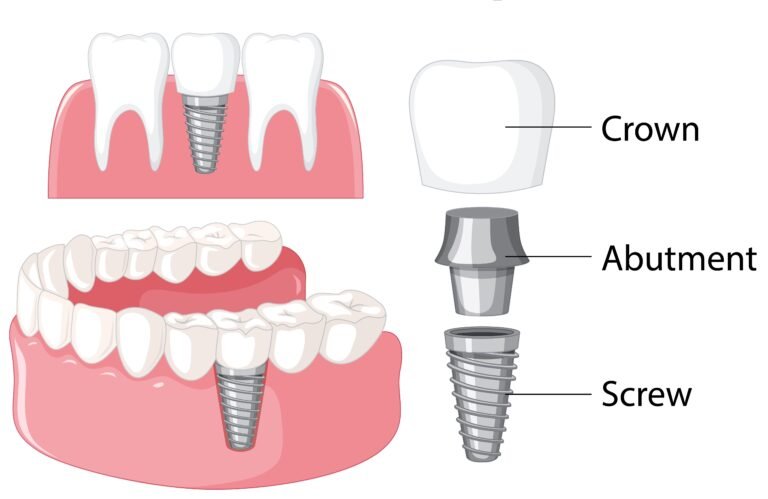
Dental implants are a popular treatment for replacing missing teeth. They give a natural appearance, improve chewing function, and help in maintaining bone health in the long-term. However, this is possible only with the careful selection of components used in the procedure. In a dental restoration system, there are two important components:
- Abutment: It is a connector between a dental implant and a prosthesis, such as a crown, dental bridge, or denture.
- Crown: It is a tooth-shaped cap that is fixed to a tooth to restore its shape, size, strength, and appearance.
The choice of the abutment and crown largely affects the success of the implant restoration. In this article, we’ll help you understand what custom abutment and screw-retained implant crowns are and how to make a choice between them.
Custom Abutment
Custom abutments are precisely designed to fit the unique implant site of the patient, which allows for seamless integration between the implant and the final restoration. These abutments are milled from materials like titanium, zirconia, or gold-colored noble metals, to give a more personalized fit for the unique anatomy of the patient’s mouth. Also, these can support a dental crown well, which is the visible portion of the tooth restoration.
Custom abutments offer a number of benefits in dental restoration including superior fit, optimal aesthetics, and versatility to address challenging cases. One of the major benefits of custom abutment is that it preserves the soft tissue contours, which are important in the esthetic zone.
Before you make a decision, you must also be aware of the potential drawbacks. Custom abutments are costlier. Since they are custom-made, they need added time in designing and production.
Screw-retained implant crowns
A type of dental implant, a screw-retained implant crown is directly fastened to the implant abutment using a screw. Unlike their contemporary cemented-retained crowns which are fixed in place using dental cement, screw-retained crowns can be easily removed for maintenance or repair. Moreover, there is less risk of damage to the implant during repairs.
Screw-retained implant crowns are a reliable and convenient solution and are a preferred choice for the replacement of the rear teeth, and front teeth in specific cases.
Talking about the disadvantages of screw-retained crowns, one of the major concerns is the access hole for the screw, which may not look nice aesthetically, especially if it is in the front teeth. Plus, the access hole needs to be covered with a filling which may create a non-uniform appearance. Screw-retained crowns are more expensive and need frequent tightening and maintenance.
When Should You Use a Custom Abutment?
A custom abutment is typically recommended when standard or stock abutments cannot provide optimal support, aesthetics, or alignment for the final restoration. Because it is designed specifically for an individual patient’s implant position and soft tissue profile, a custom abutment allows for improved emergence profile, better crown support, and more predictable long-term outcomes.
Custom abutments are particularly useful in cases where the implant has been placed at an angle, where soft tissue contours require precise shaping, or when the restoration is located in the aesthetic zone. By tailoring the abutment to the patient’s anatomy, clinicians can achieve improved crown positioning, better gingival support, and enhanced overall prosthetic stability.
They are also preferred in complex restorative cases, including multi-unit restorations or situations where achieving ideal crown margins with a stock abutment would be challenging. In such cases, a custom abutment provides greater flexibility in design and ensures a more natural and functional final result.
When Are Screw-Retained Crowns Preferred?
Screw-retained crowns are often preferred in implant restorations where retrievability, ease of maintenance, and long-term serviceability are key considerations. Because the crown is secured directly to the implant or abutment with a screw rather than cement, it can be removed when necessary without damaging the prosthesis or surrounding structures.
This type of restoration is commonly used in posterior regions, full-arch implant cases, and situations where future adjustments or repairs may be required. The ability to access and remove the crown allows clinicians to manage complications such as screw loosening, component wear, or peri-implant maintenance more efficiently.
Screw-retained crowns also eliminate the risk of residual cement, which has been associated with peri-implant inflammation and bone loss. For this reason, they are often considered a safer and more predictable option in cases where maintaining peri-implant health is a priority.
Clinical Workflow: Custom Abutment with Screw-Retained Crown
The fabrication of a custom abutment combined with a screw-retained crown typically follows a digital or conventional workflow designed to ensure precise fit and optimal prosthetic function.
The process begins with accurate implant placement and healing. Once osseointegration is confirmed, an impression or digital scan is taken using a scan body or impression coping to capture the exact position and angulation of the implant.
Using this data, the dental laboratory designs a patient-specific abutment using CAD software. The custom abutment is then milled from materials such as titanium or zirconia, ensuring precise adaptation to both the implant platform and the surrounding soft tissue.
After the abutment is fabricated, the screw-retained crown is designed to fit securely over it. The final restoration is delivered and secured using the appropriate torque value recommended by the implant manufacturer. The screw access channel is then sealed, completing the restoration while still allowing future retrievability if needed.
Custom Abutment vs Stock Abutment
Stock abutments are prefabricated components manufactured in standard shapes and sizes. While they are suitable for straightforward implant cases, they may not always provide ideal support or aesthetics in more complex situations.
In contrast, custom abutments are designed specifically for the patient’s implant position and soft tissue anatomy. This individualized design allows for better emergence profile, improved crown contour, and more accurate margin placement, especially in visible areas of the mouth.
While stock abutments are generally more cost-effective and readily available, custom abutments offer superior prosthetic outcomes in cases where precision and aesthetics are critical. The choice between the two depends on clinical requirements, implant positioning, and the desired final appearance of the restoration.
Conclusion
When choosing between custom abutment and screw-retained implant crowns or any other component, you must consider your aesthetic requirement, implant preference, clinical access, and budget. With the right choice, you can achieve a beautiful, functional and long-lasting dental implant restoration that’ll make you feel confident and happy. To find the best option for yourself, it is advised to discuss with your dentist and get their advice for your specific needs. If you are looking for a full service dental lab in Houston for your dental restoration, look nor further than Uptown Dental Lab & Milling Center. We use the highest quality material at the more affordable price. Talk to us to know more.
FAQ'S
What is a custom abutment in dentistry?
A custom abutment is a patient-specific implant component designed to connect the dental implant to the final crown. Unlike stock abutments, which come in standard shapes, a custom abutment is digitally designed and fabricated to match the exact angulation, depth, and soft tissue contour of the implant site. This personalized design helps achieve better aesthetics, improved crown fit, and enhanced long-term stability.
Are screw-retained crowns better than cement-retained crowns?
Screw-retained crowns are often considered advantageous because they allow for easy removal and maintenance of the restoration. This retrievability makes it possible to access the implant and surrounding structures if adjustments or repairs are required.
Cement-retained crowns, on the other hand, may offer improved aesthetics in certain cases because they do not have a visible screw access channel. The choice between the two depends on implant position, aesthetic requirements, and the clinician’s treatment planning preferences.
Can a custom abutment be used with a screw-retained crown?
Yes, a custom abutment can be used in combination with a screw-retained crown. In such cases, the abutment is designed to provide optimal support and alignment, while the crown is secured using a screw mechanism. This approach combines the aesthetic and anatomical advantages of a custom abutment with the retrievability and maintenance benefits of a screw-retained restoration.
How long do screw-retained implant crowns last?
Screw-retained implant crowns are designed to be durable and long-lasting when properly fabricated and maintained. With good oral hygiene, regular dental check-ups, and proper occlusal management, these restorations can last many years. Periodic evaluation is recommended to monitor screw stability, prosthetic wear, and peri-implant tissue health, ensuring the longevity of the implant restoration.